Autumn Mushrooms: A Rich Palette for Design and Nature-Inspired Creativity
Autumn Mushrooms evoke more than seasonal foraging or woodland walks—they embody texture, transformation, and quiet abundance. Their caps range from burnt umber and russet to ochre and deep moss green; their gills whisper delicate geometry; their stems carry the sturdy elegance of organic form. This natural motif has long inspired artists, textile designers, and typographers—and now, it lives vividly in a distinctive full-color font that bridges botanical observation with digital craftsmanship.
Where Fungi Meet Font Technology
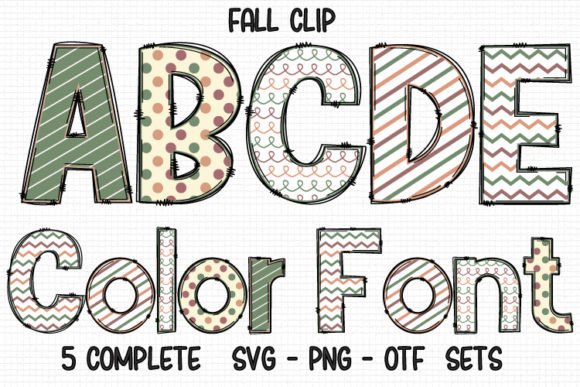
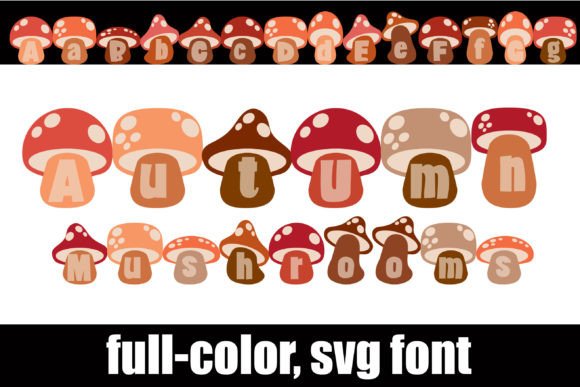
This full-color font—designed with Autumn Mushrooms as its thematic anchor—translates mycological detail into typographic language. Each uppercase letter features hand-stitched visual cues: subtle cross-stitch textures, visible embroidery needles, and looping thread elements rendered in an intentional autumn color palette. The “A” might hold a needle piercing through a rust-colored cap; the “M” could echo the layered gills of a porcini with golden-thread accents; the “R” may curl like a dried chanterelle stem, wrapped in amber thread.
Unlike standard OpenType fonts, this is an SVG-based color font, meaning each glyph contains embedded vector graphics with multiple colors, gradients, and transparency—preserving fidelity at any scale. It’s not just colored text; it’s illustrated typography. That distinction matters for creators who need expressive, production-ready assets without layering effects or raster workarounds.
Why Color Fonts Are Transforming Creative Workflows
For decades, designers relied on outlines, fills, and manual effects to simulate texture or dimension in type. Full-color SVG fonts eliminate those steps. When used in compatible software, they behave like native fonts—adjustable via keyboard input, resizable without pixelation, and editable in real time. This shifts how professionals approach layout, branding, and craft-oriented design.
Consider a small-batch soap maker launching a fall collection named “Honey Fungus.” Instead of commissioning custom lettering or assembling layered vectors in Illustrator, they install the Autumn Mushrooms font and type the title directly into Silhouette Studio. Instantly, “HONEY FUNGUS” appears in rich, stitch-textured letters—ready for vinyl cutting, heat transfer, or print-ready PDF export. No tracing. No plugin dependencies. Just intuitive, scalable expression.
Educators use similar fonts to create tactile learning posters—letters that visually reinforce seasonal science units. A biology teacher might display “MYCELIUM,” “SPORE,” and “DECAY” in this font alongside illustrations of fungal networks, helping students connect vocabulary to visual metaphor. The cross-stitch aesthetic subtly reinforces themes of interconnection and handmade knowledge—ideas central to both ecology and craft education.
Compatibility: Knowing Where Your Letters Will Bloom
Full-color SVG fonts operate within a specific technical ecosystem. They install like traditional .otf files—via Font Book (macOS), Windows Settings > Fonts, or third-party managers like NexusFont—but their color rendering depends entirely on application support.
- Silhouette Studio (v5.0+) renders them natively, making them ideal for makers using CAMEO or Portrait machines.
- Adobe Illustrator and Photoshop (CC 2020+) support them when opened in newer document formats (.ai, .psd) and when the font is selected post-installation—not always visible in font menus until typed.
- Inkscape (v1.2+) displays colors correctly when SVG fonts are enabled in Preferences > Input/Output > Fonts.
- QuarkXPress, CorelDRAW (2023+), and Gravit Designer also offer varying levels of support.
Crucially, many programs—including older Adobe versions, Microsoft Office, and web browsers—fall back to monochrome outlines. That’s expected behavior, not a flaw. The font isn’t “broken”; it’s operating within specification. Designers working across platforms should treat it as a display-only asset: perfect for final artwork, signage, packaging, or social banners—but not for body copy in multi-platform documents where consistency is non-negotiable.
Practical Applications Across Disciplines
The versatility of this Autumn Mushrooms font extends far beyond novelty. Its strength lies in context-aware utility:
Hobbyists & Crafters
Embroiderers use it to mock up hoop designs before stitching—typing a phrase, then exporting as SVG to trace onto fabric. Candle makers apply it to laser-cut wooden labels, where the thread motifs echo wick textures. Even knitting pattern designers incorporate the font into PDF headers, reinforcing seasonal themes without licensing stock art.
Small Business Owners
A local apothecary launching a mushroom tincture line can unify branding across labels, Instagram posts, and farmers’ market banners using one consistent typographic voice. Because the font scales infinitely, a tiny jar label and a 48″ trade show banner share identical visual DNA—no redrawn logos, no mismatched tones.
Educational Publishers
Rather than licensing separate illustrations for every seasonal vocabulary list, curriculum designers embed the font directly into worksheets. “Lichen,” “Fruiting Body,” and “Hyphae” appear not as plain text but as visual anchors—supporting multimodal learning while reducing production overhead.
Urban Foragers & Nature Educators
Field guide apps and printable trail maps benefit from legible, thematic typography. A park district might use the font for interpretive signs about native fungi—pairing scientific names in clean sans-serif with common names (“Lobster Mushroom,” “Wood Ear”) in the Autumn Mushrooms font. The contrast signals accessibility without sacrificing authority.
Design Considerations Beyond Aesthetics
Using color fonts thoughtfully requires attention to hierarchy, contrast, and intent. Because each glyph carries visual weight, the Autumn Mushrooms font performs best at larger sizes—headlines, titles, poster text, or single-word emphasis. Setting paragraphs in it would overwhelm readers and dilute its impact.
Pairing matters too. It harmonizes with organic sans-serifs (like Brilliant Pro or Work Sans) for body text, or with textured serif faces (such as IM Fell DW Pica) for vintage-inspired layouts. Avoid pairing it with other highly decorative fonts—the thread and needle motifs already provide ample personality.
Accessibility is another layer. While the font itself isn’t screen-reader hostile (it remains Unicode-compliant), its dense textures reduce legibility for low-vision users at small sizes. Best practice: use it for visual emphasis only, and always provide alt text or adjacent plain-language labels in digital contexts.
Seasonal Typography as Cultural Resonance
Typography rooted in natural cycles—like Autumn Mushrooms—does more than decorate. It participates in cultural storytelling. In Japan, matsutake season is marked by poetry, markets, and reverence for transience. In Scandinavia, foraging chanterelles is interwoven with folklore and sustainability ethics. This font doesn’t replicate those traditions—it invites creators to engage with them intentionally.
A wedding stationer designing invitations for a forest ceremony might use the font for the couple’s names, then echo the thread motif in hand-tied ribbon or pressed ferns. A climate researcher presenting data on soil health could feature “Mycorrhiza” in the font during a keynote slide—making abstract symbiosis momentarily tangible.
That resonance emerges not from gimmickry, but from fidelity: to fungal forms, to craft traditions, and to the technical precision that lets those ideas travel across tools and disciplines.
Installation and Troubleshooting Tips
Installation is straightforward—but clarity prevents frustration:
- Download the .otf file (not .zip unless extracted).
- Double-click to open the font preview; click “Install Font” (macOS) or “Install” (Windows).
- Restart your design application—some programs cache fonts on launch.
- Open a new document, select the font, and type. If letters appear black, check compatibility first—don’t assume corruption.
- For Silhouette Studio users: ensure you’re in Designer Edition or higher, and that “Use System Fonts” is enabled in Preferences > General.
If colors still don’t appear, test in a known-compatible app like Illustrator first. That isolates whether the issue lies with the font, the software version, or the document settings.
Looking Ahead: Where Autumn Mushrooms Fit in Design Evolution
As vector-based color fonts mature, we’re moving past static “fonts-as-outlines” toward dynamic, expressive systems. The Autumn Mushrooms font exemplifies this shift—not as a standalone novelty, but as part of a broader movement toward contextual typography: type that adapts its meaning through material reference, seasonal rhythm, and tactile suggestion.
Future iterations may include variable axes—adjusting stitch density, thread thickness, or cap saturation—or companion glyphs for spore prints, mycelial networks, or forest floor textures. But even in its current form, it serves a quiet, practical purpose: helping creators translate wonder into work—whether that work is labeling a jar of wild-foraged tincture, teaching students about decomposition, or designing a poster that makes passersby pause, recognize the shape of a familiar cap, and feel the hush of an October woods.