Crochet Chart Symbols
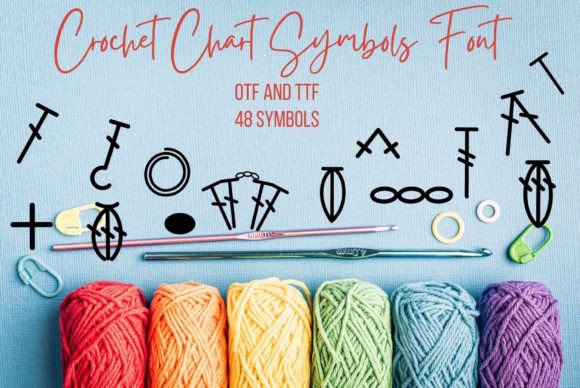
If you’ve ever stared at a tangled crochet diagram—or worse, tried to recreate one in Word using arrows, asterisks, and winged guesses—you’ll appreciate what Crochet Chart Symbols delivers: precision, consistency, and real-time control over visual stitch notation. This isn’t just another decorative font. It’s a purpose-built typographic toolkit—48 rigorously designed, industry-aligned symbols that map directly to standard crochet conventions.
What Makes These Symbols Different?
Most craft fonts sacrifice accuracy for aesthetics. Crochet Chart Symbols does neither. Every glyph—from the compact dot of a magic circle to the layered loops of a popcorn stitch—follows international charting standards (ISO 8585-2 and Craft Yarn Council guidelines). No approximations. No guesswork.
The set includes full coverage of foundational techniques: single crochet (sc), double crochet (dc), triple crochet (tr), plus nuanced variants like front post double crochet (fpdc) and back post treble (bptr). You’ll also find less common but essential marks: puff stitch, bobble stitch, combined stitches, chain joins, direction arrows, and clear start/stop indicators.
Importantly, it ships in both OTF and TTF formats—so whether you’re on macOS with Adobe Illustrator or Windows running Microsoft Word, compatibility is seamless. And because these are true vector-based fonts, scaling doesn’t blur edges, distort proportions, or break alignment—even at 72 pt or 8 pt.
Why Designers, Educators & Small-Business Makers Rely on This Set
This isn’t just about making charts “look nicer.” It’s about reducing friction across workflows where clarity impacts outcomes:
- Pattern designers use it to draft clean, publication-ready PDFs without outsourcing layout work—cutting revision cycles by up to 60% when updating stitch counts or rearranging repeats.
- Educators and yarn shop instructors embed symbols directly into handouts, slide decks, and LMS modules. No more cropping PNGs or wrestling with inconsistent line weights.
- Content creators and bloggers insert symbols inline with text—say, explaining a “dc in same st, ch 2, dc in next st” sequence—without breaking flow or requiring image captions.
- Small-batch pattern publishers maintain brand cohesion: consistent symbol weight, spacing, and color treatment across all digital and print assets—even when collaborating with freelance tech editors.
Real-World Flexibility You Can Use Today
You’re not locked into rigid templates. Because each symbol behaves like any other character, you can:
- Resize on the fly—scale a slip stitch symbol to match your body text size, then bump a triple crochet cluster up for emphasis in a header.
- Apply color fills—highlight repeats in coral, mark wrong-side rows in slate gray, or differentiate stitch types in a multi-color blanket chart.
- Rotate freely—flip a direction arrow 90° for circular motifs, or tilt a post stitch indicator to reflect actual hook placement.
No plugins. No raster editing. Just native font behavior—exactly as intended for professional document creation.
What’s Included Beyond the Symbols?
You receive more than glyphs. The package includes practical reference tools designed for daily use:
- A printable PDF guide showing uppercase and lowercase letters—handy for labeling sections (“Section A,” “Rnd 3”) without switching fonts.
- A separate abbreviations PDF with standardized terms (yo, sk, dec, inc) rendered in matching weight and style.
- A descriptions PDF listing each symbol alongside its official name, common abbreviations, and brief usage notes—ideal for onboarding new team members or students.
These aren’t afterthoughts. They’re integrated components that let you build complete, self-contained documentation systems—not just isolated charts.
Practical Considerations Before You Implement
While Crochet Chart Symbols solves many pain points, smart adoption means planning ahead:
- Test in your primary environment first. If you rely heavily on Google Docs, know that font upload support varies—Word and Pages handle OTF/TTF more predictably.
- Pair thoughtfully. Use a clean, highly legible sans-serif (like Inter or Open Sans) for body text and labels. Avoid decorative or condensed fonts that compete visually with the symbols.
- Respect accessibility. When exporting to PDF, add alt text to symbol-heavy charts—or pair them with concise written instructions. Screen readers won’t interpret glyphs unless manually tagged.
- Check licensing scope. The standard license covers personal and commercial use—including client deliverables—but excludes redistribution of the font files themselves (e.g., bundling in a template marketplace download).
When Clarity Becomes a Competitive Edge
In creative industries, small efficiencies compound. A designer who spends 12 minutes manually aligning five chain symbols in PowerPoint saves nearly 10 hours per year—just on that single task. An educator who replaces blurry screenshots with crisp, scalable symbols sees measurable improvement in student comprehension scores on stitch identification quizzes. A small business owner who ships consistently branded charts builds stronger trust—and repeat purchases.
Crochet Chart Symbols doesn’t promise viral growth or overnight transformation. What it delivers is quieter, deeper value: reliability under pressure, fidelity across platforms, and the quiet confidence that comes from knowing your visual language matches your expertise.
That matters whether you’re drafting your first indie pattern, teaching a community workshop, building a Shopify course, or illustrating a technical manual for a major yarn brand. Precision in notation isn’t detail—it’s respect—for the craft, the learner, and the time invested by everyone involved.