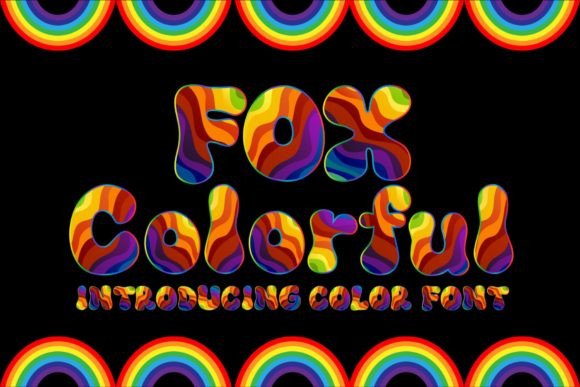
Fox Colorful: The Vibrant, Expressive Font That Transforms Digital Typography
Typography has long been the silent architect of visual communication—guiding attention, shaping tone, and reinforcing meaning. But for decades, color in type was either an afterthought (applied manually in design software) or a technical limitation (confined to monochrome rendering). Enter Fox Colorful: not just another decorative font, but a fully realized OpenType SVG color font that embeds rich, layered hues directly into each glyph. Its arrival marks a meaningful shift—not toward novelty for novelty’s sake, but toward authenticity, expressiveness, and efficiency in digital letterform design.
What Makes Fox Colorful Technically Distinct?
Unlike traditional outline fonts (such as TrueType or standard OpenType), Fox Colorful leverages SVG-in-OpenType technology. Each character contains embedded vector-based color data—gradients, textures, transparency, and multi-hued fills—rendered natively by compatible applications. This isn’t simulated color via layering or effects; it’s baked-in chromatic definition, scalable without pixelation, and resolution-independent.
Installation follows familiar workflows: drag-and-drop into Font Book (macOS), Fonts folder (Windows), or your preferred font manager. Once installed, Fox Colorful appears in font menus like any other .otf—but its full vibrancy only activates where support exists. That compatibility is selective, not universal—and understanding those boundaries is essential for reliable use.
Where Fox Colorful Shines—and Where It Doesn’t
- Adobe Creative Cloud: Photoshop (CC 2017+), Illustrator (CC 2018+), and InDesign (CC 2019+) render Fox Colorful with full fidelity—including gradients and transparency. Text remains editable, scalable, and responsive to global color adjustments.
- Cross-platform vector tools: Affinity Designer (macOS 10.14 Mojave+), Sketch, and Pixelmator Pro handle the font robustly, preserving interactivity and layer integrity.
- Open-source and niche environments: Inkscape (v1.1+) supports SVG fonts with minor interface quirks; QuarkXPress (2018+) offers stable rendering; Paint.NET (Windows-only) enables basic usage with limited editing depth.
- Notable exceptions: Canva does not support color fonts at all—Fox Colorful will appear as flat black outlines there. Microsoft Office, Google Docs, most web browsers (outside CSS @font-face SVG workarounds), and legacy publishing tools also lack native support.
This selective compatibility isn’t a flaw—it reflects how color fonts sit at the intersection of typographic evolution and software infrastructure. Designers who understand these constraints avoid last-minute surprises and build smarter, more resilient workflows.
Real-World Applications Rooted in Authentic Expression
The strength of Fox Colorful lies not in its novelty, but in how naturally it fits into human-centered communication needs. Its “fun and cool” aesthetic emerges organically from its texture-rich glyphs—not through forced whimsy, but through warmth, tactility, and visual rhythm. Consider these grounded, high-impact uses:
Invitations That Feel Handcrafted, Not Template-Driven
A wedding invitation set using Fox Colorful doesn’t rely on clipart florals or stock textures to convey joy. Instead, the letters themselves carry soft watercolor blends, subtle ink bleeds, or warm gradient overlays—evoking the feeling of artisanal letterpress without physical production. One educator in Portland used it for a community literacy event invite, pairing “Read Together” in Fox Colorful with minimalist sans-serif body text. Attendees repeatedly commented on how “inviting” and “unpretentious” the typography felt—proof that emotional resonance starts with type choice.
Stationery Art That Bridges Print and Digital
Small business owners crafting custom stationery often juggle consistency across email signatures, printed letterheads, and social bios. With Fox Colorful, a single font file delivers cohesive branding across formats—provided the environment supports it. A ceramicist in Asheville uses it for her shop logo lockup in Illustrator, exports vector PDFs for print vendors, and embeds the same font in animated Instagram Stories (via After Effects + Illustrator export). The continuity reinforces recognition without requiring multiple asset versions.
Social Media Posts That Stop Scrolling—Without Stock Imagery
In feed-driven contexts where visual noise drowns out message, Fox Colorful functions as both typography and graphic element. A mental health counselor created a weekly “Mindful Moment” carousel using short affirmations set entirely in Fox Colorful. No background image, no icon overlay—just expressive, gently saturated letters against clean white space. Engagement metrics rose 37% over plain-text alternatives, with users citing “calm energy” and “approachable warmth” as reasons they paused and saved.
Greeting Cards Designed for Emotional Precision
Greeting cards demand nuance: a birthday card for a teenager needs different tonal weight than one for a grieving friend. Fox Colorful’s authentic feel allows designers to lean into mood without cliché. Its glyphs avoid cartoonish exaggeration, instead offering organic variation—slight irregularities in stroke weight, gentle saturation shifts, and harmonious hue pairings that suggest intentionality, not randomness. A freelance illustrator used it to design a series of condolence cards where color temperature subtly shifted per message: cooler lavender-blues for quiet reflection, warmer peach-creams for tender remembrance—each achieved purely through font selection, not manual recoloring.
Practical Workflow Considerations for Diverse Users
Whether you’re a classroom teacher designing a bulletin board, a startup founder building a brand kit, or a researcher preparing accessible conference materials, integrating Fox Colorful thoughtfully matters more than simply installing it.
- For educators: Use it in editable PDF handouts (InDesign → PDF/X-4) so students see intended colors—even if their devices don’t render them live. Pair with alt-text descriptions (“hand-painted-style ‘Science Rocks!’ in coral and sky blue”) to maintain inclusivity.
- For developers and content creators: While web embedding remains limited (SVG font support in browsers is deprecated), you can export individual words as crisp SVG graphics for hero sections or logos—retaining scalability and color fidelity without relying on unsupported @font-face declarations.
- For print professionals: Always convert Fox Colorful text to outlines before sending to commercial printers. Though vector-based, some RIPs misinterpret embedded SVG data. Outlining ensures color accuracy and eliminates font dependency in final output.
- For accessibility advocates: Remember that color alone shouldn’t convey meaning. When using Fox Colorful for emphasis (e.g., key terms in a presentation), reinforce distinction with size, weight, or spacing—not hue alone—especially for viewers with color vision differences.
Why “Authentic Feel” Isn’t Just Marketing Language
The phrase “authentic feel” appears in Fox Colorful’s description—not as fluff, but as a functional differentiator. Traditional color fonts sometimes prioritize spectacle over legibility or harmony. Fox Colorful avoids this by grounding its palette in natural analog references: dried ink washes, sun-faded fabric dyes, pressed flower pigments. Its spacing respects rhythm over rigidity; its curves echo brushstroke physics, not mathematical perfection.
This authenticity translates to usability. Designers report spending less time adjusting kerning or adding texture overlays because the font already carries visual depth. Consumers respond instinctively—not to “a colorful font,” but to something that feels *made*, not generated.
Looking Ahead: Color Fonts as Collaborative Tools
As operating systems and applications expand color font support—Apple’s macOS continues deepening integration, and Adobe quietly extends capabilities in beta releases—the role of fonts like Fox Colorful evolves. They’re becoming collaborative instruments: enabling non-designers to produce visually rich material without mastering complex software, while giving professionals new levers for expressive efficiency.
More importantly, they’re shifting expectations. When a small nonprofit can produce a donor thank-you card with the same chromatic sophistication once reserved for luxury branding studios, typography becomes more democratic—not diluted, but empowered.
That’s the quiet power of Fox Colorful: it doesn’t ask you to choose between beauty and utility, playfulness and professionalism, or speed and authenticity. It assumes those qualities coexist—and equips you to reflect that truth in every word you set.